
You know the kind of afternoon we mean. The sky over Montgomery goes the color of a nickel, and then the bottom falls out. One minute you can see the traffic light at the end of the block, and about twenty seconds later you are looking at a gray smear where the road used to be.
That twenty seconds is the whole test, with no warning and no chance to pull over first. Most drivers file it under wipers. It is bigger than that. Five systems have to hold up at once: the wiper blades, the washer fluid and the nozzles that deliver it, the defroster that keeps the inside of the glass clear, the headlights that put usable light on the pavement, and the tires that keep the car planted in standing water.
Any one of them can fail quietly for months, because you only find out mid-storm. Searching for auto repair near me from a parking lot with the rain coming sideways is a bad time to learn which one let you down. Here is how to find out in your driveway instead.
Why Montgomery Storms Test Everything at Once
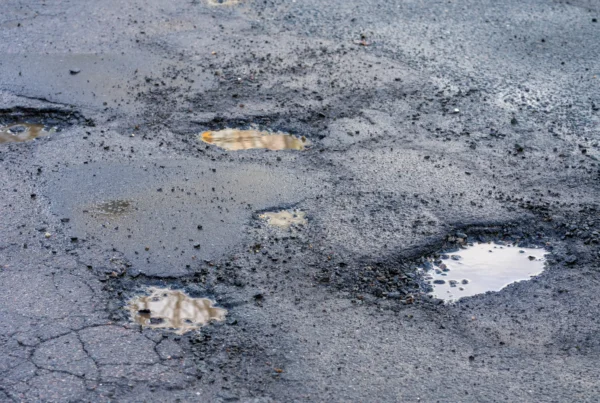
Montgomery is a wet city. U.S. Climate Data puts our annual precipitation at 53.07 inches, and July alone averages 5.24 inches, with June, August and September all clustered around four inches. That rain does not arrive politely spread across the month. It comes in short, violent Gulf-moisture cells that open up over Zelda Rd on a Tuesday afternoon and are gone before supper.
Those conditions are also where the crashes are. The Federal Highway Administration reports that 75 percent of weather-related vehicle crashes happen on wet pavement, and 47 percent happen while it is actually raining. Crashes on wet pavement kill nearly 5,700 people and injure more than 544,600 every year. Crashes during rainfall account for over 3,400 deaths and more than 357,300 injuries.
Drivers do slow down, but not by much. FHWA data shows speeds drop 10 to 25 percent on wet arterial routes, and freeway speeds fall only 3 to 17 percent in heavy rain. So a lot of people are moving at close to normal speed on Eastern Boulevard or I-85 with far less than normal visibility and traction, and every auto repair Montgomery AL shop sees the results all summer.
Windshield Wiper Replacement Montgomery Drivers Keep Putting Off
A wiper blade is not on a mileage clock. It is on an exposure clock. AAA puts modern blade life at 6 to 12 months, and the variables it names are heat, dust, dirt, UV radiation and acid rain. Think about a car that sits in an uncovered lot off the Atlanta Highway from May through September. Alabama sun does not put you at the twelve month end of that range.
The trouble is that a bad blade often looks fine. The rubber can harden, glaze, or wear a rounded edge where it used to have a sharp wiping lip, and none of that shows up from six feet away. So use your finger.
- Lift the arm off the glass and run a fingertip slowly along the rubber edge. You are feeling for nicks, splits, gritty hardening, or an edge that feels rounded instead of crisp.
- Look at the edge from the side. A healthy blade has a defined lip. A worn one is blunt.
- Check the arm itself. If the spring has weakened, the blade will not press evenly and the outer third of the sweep will streak no matter how new the rubber is.
On the glass, the symptoms are just as readable:
- Streaking in the same spot every pass usually means a damaged edge.
- Chattering or skipping across the windshield often means hardened rubber or a bent arm.
- A hazy film left after the wipe means the blade is smearing road grime rather than clearing it.
New blades are the fastest fix on this whole list, usually done while you wait. If you want to know what a correct set for your specific vehicle involves, ask us for a current quote rather than guessing from a shelf tag.
Washer Fluid and the Nozzles Nobody Checks
Here is the part almost everyone forgets. In the first minute of a downpour, the rain does not wash your windshield. It lifts months of road film and pollen off the glass and turns it into a paste, and your first wipe spreads it edge to edge. Without washer fluid at that moment, you are worse off than before you turned the wipers on.
Two things fail here, and both are silent:
- The reservoir is empty. Most people top it off in spring and never think about it again. By late summer it is dry.
- The nozzles are clogged or misaimed. Wax, road tar and mineral deposits block the tiny outlets, and a nozzle knocked out of alignment by a car wash sprays over the roof instead of onto the glass.
Test it in the driveway, not at 55 miles an hour. Pull the washer stalk with the car parked and watch where the spray lands. It should hit the upper half of the windshield in the path the blades sweep. If one side dribbles or the stream shoots too high, that nozzle needs cleaning or aiming. While you are there, top the reservoir with real washer fluid, because plain water does not cut road film.
Why Your Defroster Turns On the Air Conditioning
Now the failure that confuses people most. You get the outside of the glass clear, and the inside fogs over anyway.
Different problem, different cause. As AAA explains it, when the cabin gets warmer than the air outside, the moisture from your breath and your damp clothes condenses on the inside of the windshield. Wipers cannot touch it, and wiping it with your hand just leaves streaks that catch every headlight coming at you.
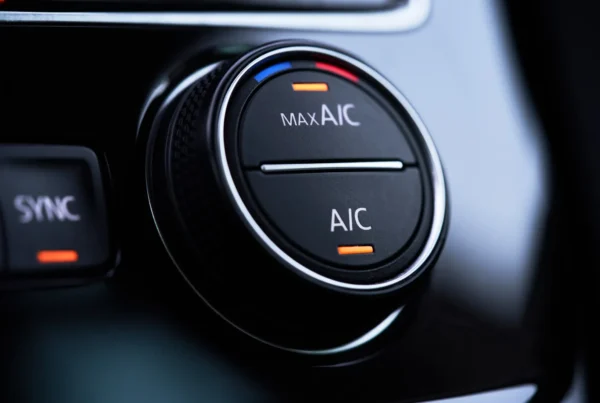
The fix is your defroster, and here is why the AC light comes on by itself when you select defrost on most vehicles. The system routes air across the air conditioning evaporator first. Cold coils pull moisture out of that air, and the air is reheated before it reaches the glass. Warm dry air absorbs cabin moisture far faster than warm damp air ever could. AAA describes running the air conditioner as acting like a dehumidifier for the interior.
That is why an AC system that is not working properly costs you more than comfort. It costs you your defroster in a rainstorm. If the AC light comes on in defrost mode and the glass still takes forever to clear, that is worth booking AC service before the next storm rather than after.
One more thing AAA points out that helps immediately: turn off recirculate. Recirculating traps the humid cabin air you are trying to get rid of. Outside air, even rainy outside air, is usually drier than the air inside a car full of wet people.
Hazed Headlights Cost More Light Than You Think
Alabama law does not leave headlights to your judgment during a storm. Under Code of Alabama section 32-5-240, lighted lamps are required from a half hour after sunset to a half hour before sunrise, any time your windshield wipers are running because of rain, sleet or snow other than intermittent misting, and any time there is not enough light to make people and vehicles clearly discernible at 500 feet. Wipers on, lights on. That is the rule.
Which raises the obvious question: how much light are your headlights actually producing? If the lenses have gone cloudy or yellow, the honest answer is startling. AAA had an accredited laboratory test headlights from two popular sedans that were roughly 11 years old. On low beam, those deteriorated headlights delivered just 22 percent of the light a new headlight produces.
The cause is sunlight. UV exposure breaks down the plastic lens and gives it that milky, yellowed look. It also comes on gradually, so your eyes adjust and you never notice how little you are seeing.
AAA also measured the repair options, and the results are worth knowing before you decide:
- Professional and do-it-yourself restoration returned light output to roughly 70 percent of new.
- Aftermarket replacement assemblies restored 83 to 90 percent.
- Original equipment replacement was the only method that brought output back to 100 percent.
- Both restoration and aftermarket parts produced more glare than DOT criteria allow, which matters for the driver coming at you.
That is the honest answer on headlight restoration Montgomery AL drivers ask us about every fall. It is a real improvement over a hazed lens, but it is not the same as new. Which route makes sense depends on your vehicle and the condition of the lens. Let us look at yours and give you a current quote for the options rather than working from a number you read somewhere.
Standing Water Is a Tire Problem Before It Is a Driver Problem
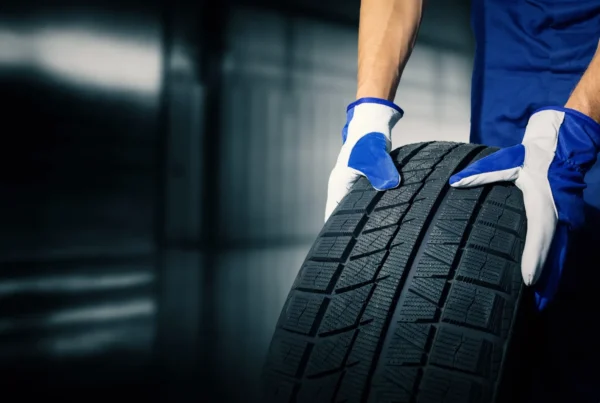
You can see the standing water pooling in the right lane of I-85 perfectly and still slide through it. Tread grooves exist to give water somewhere to go so the rubber can stay in contact with pavement. When those grooves get shallow, the water has nowhere to escape, it lifts the tire, and steering and braking stop meaning anything.
AAA tested this at highway speed on wet pavement. Tires worn to a tread depth of 4/32 of an inch increased average stopping distance by 43 percent, an extra 87 feet for a passenger car and 86 feet for a light truck, compared with new tires. Handling ability dropped 33 percent for the passenger car and 28 percent for the light truck.
Note that 4/32 is not the legal wear-out point. It is the depth where AAA says wet stopping distance has already deteriorated significantly, which is why they recommend shopping for tires at that point rather than waiting. The check takes ten seconds: slip an upside-down quarter into a tread groove and look at Washington’s head. If you can see all of it, your tread is at or near that mark.
Check several grooves on all four tires. Uneven wear usually points at alignment or an inflation problem the Alabama heat has been working on all summer rather than at the tires themselves.
Driveway Checks Versus What a Shop Verifies in One Visit
Plenty of this you can do yourself on a Saturday. Some of it you cannot.
What you can check in your driveway in about five minutes:
- Run a fingertip along both wiper blade edges for nicks, hardening and a rounded lip
- Run the wipers on a wet windshield and watch for streaking, chattering or haze
- Pull the washer stalk, confirm both nozzles spray onto the swept area, then top off the reservoir
- Look at your headlight lenses in daylight for clouding or yellowing
- Check tread depth with an upside-down quarter in several grooves on all four tires
What a shop confirms in a single visit:
- Blade and wiper arm condition together, including arm spring tension and correct blade fitment
- Washer pump output, hose condition, and nozzle cleaning or aiming
- Whether the AC system is holding proper charge, since that is what dries the air for your defroster
- Headlight aim along with lens condition, and which restoration or replacement route suits your vehicle
- Tread depth measured with a gauge across the whole tire, plus inflation, wear pattern and any alignment issue behind it
That second list is why one shop looking at the whole visibility system at once beats chasing it part by part. Sexton Tire & Auto has been doing exactly that for Montgomery drivers since 1991, and we are easy to find at 2718 Zelda Rd.
Frequently Asked Questions
How often should I replace my wiper blades in Alabama?
AAA puts modern blades at 6 to 12 months depending on exposure to heat, dust, dirt, UV and acid rain. Alabama sun and an outdoor parking spot push you toward the short end. If they streak or chatter, replace them regardless of how long they have been on.
Is headlight restoration as good as new headlights?
Not quite. AAA measured restoration at roughly 70 percent of new light output and aftermarket assemblies at 83 to 90 percent, with original equipment parts the only route back to 100 percent. Restoration is still a large improvement over a hazed lens.
What does any of this cost?
That depends entirely on your vehicle and what the inspection finds, and a stale number helps nobody. Ask us for a current quote and you will get a real one for your car.
Before the next Gulf storm parks itself over Montgomery, let us look at your wipers, washers, defroster, headlights and tread in one visit. Request a quote and we will tell you exactly where you stand.