By the middle of August in Montgomery, your tires have been working through three straight months of heat. Daily highs here average in the low 90s in July, and the asphalt on Zelda Road, the Eastern Bypass, and I-85 holds that heat long after the sun goes down. Your engine has a cooling system. Your cabin has air conditioning. Your tires have neither. They just absorb it.
The National Highway Traffic Safety Administration puts it plainly: in the hot summer months, high heat and hot roadways contribute to the breakdown of tires and a greater opportunity for tire failure. The checks that protect you against it take about ten minutes in your own driveway.
Here is what the heat is doing inside your tires, why the most common summer “fix” backfires, and what to check.
Why Does Tire Pressure Go Up in Hot Weather?
Air expands when it gets hot. According to the U.S. Tire Manufacturers Association, inflation pressure moves about one to two pounds for every 10 degrees of temperature change: up in warm weather, down in cold.
Several things stack up in an Alabama summer:
- Morning to afternoon swing. Set your pressure before sunrise, then read it again after a July afternoon in the low 90s. The gauge will have moved.
- Pavement heat. Asphalt in direct sun runs far hotter than the air above it, so the surface your tires ride on is hotter than your weather app says.
- Friction from driving. A rolling tire flexes constantly, and flexing rubber makes its own heat on top of what the road adds.
So a driver who sets all four tires to the placard number at 6 a.m., then checks again at 4 p.m. after a run out I-85, will see a higher reading. Nothing is broken, and that is the reason the next section exists.
Why Bleeding Air Out of a Hot Tire Is Backwards
This is the most common mistake we see in July and August, and careful people make it while trying to do the right thing.
The number on the sticker inside your driver’s door is a cold inflation pressure. Cold means the vehicle has sat out of the sun long enough for the tires to settle to the temperature around them, which USTMA defines as at least three hours. Every recommendation your automaker makes assumes you measured under those conditions.
Picture that same driver. The gauge reads high in the afternoon heat, so they pull into a gas station and let air out until it matches the placard. It feels responsible. But overnight the tires cool, and now all four sit below the number the vehicle was engineered around.
That matters because underinflation is a heat problem in its own right. USTMA is direct about it: under inflated tires generate excessive heat build-up and stress, causing irregular wear and internal damage. NHTSA notes that pressure below the recommended level can cause high heat generation, which in turn causes rapid tire wear and blowout.
You let air out to protect the tire from heat, and the result is a tire that makes more heat than before.
The rule for tire pressure in hot weather is simple: set it cold, then leave it alone. A high reading on a hot tire is the system working, not a warning.
One more thing: a tire pressure monitoring system only has to warn you once a tire is 25 percent under inflated. That is a late alarm, and USTMA says it is no replacement for monthly checks with a gauge.
How Heat Turns a Worn or Aging Tire Into a Failure
Pressure is only half of it. The other half is the condition of the rubber itself, and heat attacks that too.
Heat accelerates aging. All rubber breaks down over time, and NHTSA notes that heat speeds the process up. Tires age whether you drive them or not, so a low-mileage second vehicle is not automatically in good shape. A tire can have plenty of tread left and still be compromised, and aging may not be visible. Some manufacturers recommend replacement at six to ten years old regardless of tread wear, spare included.
Worn tread adds to the risk. A new car tire starts with 10/32 to 11/32 of an inch of tread, and the practical replacement point is 2/32. Those last couple thirty-seconds are doing real work.
Then they combine. An aged, thin-tread tire, carrying a full load on hot pavement at highway speed, is the setup for a tread separation. Any one factor alone is usually manageable. Stacked, they are what turns an ordinary summer drive into a roadside stop.
If you are wondering whether yours are past their prime, our guide on when it is time for new tires walks through the signs.
The Summer Tire Checks Drivers Miss
None of this needs tools you do not already have. It needs doing on the right schedule, in the right condition.
- Check cold, at least monthly. First thing in the morning, before you drive anywhere, or after the vehicle has sat at least three hours out of the sun.
- Use a real gauge, not your eyes. A radial tire can be significantly low and still look fine.
- Do not wait for the light. It triggers at 25 percent under, and you want to catch a problem long before that.
- Look for cracking, bulges, and cuts. USTMA recommends inspecting for irregular tread wear, cracking, scrapes, bulges, cuts, punctures, and embedded objects. Fine sidewall cracking is heat and age showing themselves.
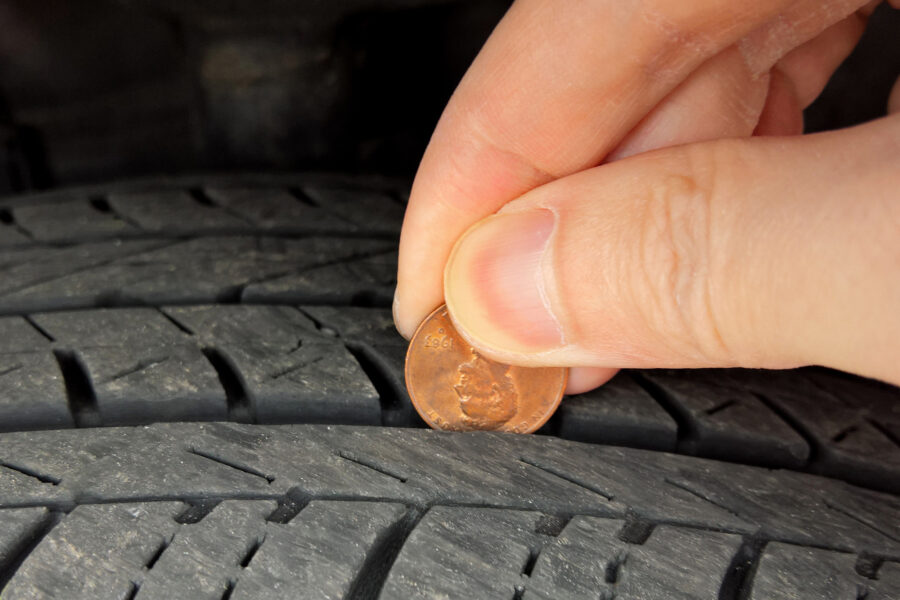
- Do the penny test. Insert a penny upside down into a tread groove. If Lincoln’s whole head is visible, you are at or near 2/32 and it is time to shop.
- Read the date code. The last four digits of the Tire Identification Number on the sidewall give the week and year the tire was built. “2619” means the 26th week of 2019.
- Do not forget the spare. It ages in the trunk too.
Uneven wear often points at something other than the tire. If your wear looks lopsided, our post on whether your vehicle is due for a wheel alignment is a good next read.
Get a Pressure and Tread Check
Sexton Tire & Auto has been serving Montgomery since 1991. Bring your vehicle by 2718 Zelda Rd and we will set your tires to the correct cold pressure, check tread across each tire, look over the sidewalls, and read the date codes, then give you a straight answer on whether your tires have another Alabama summer in them. If something needs attention, request a quote and we will give you a current price for your vehicle.