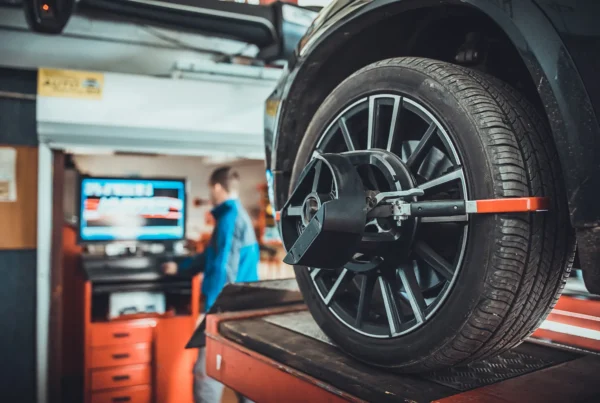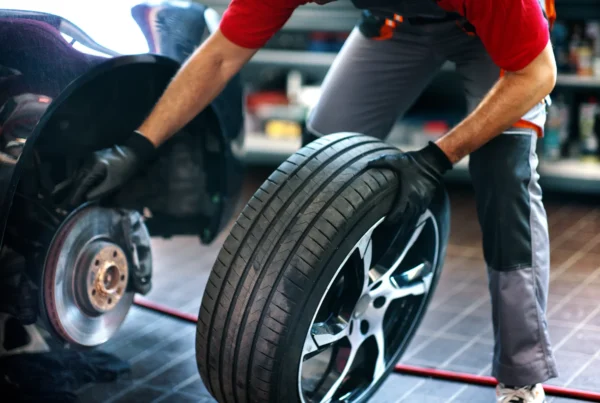

The phone rings at our shop on Zelda Road and the conversation goes almost the same way every week. A driver asks for an alignment, then describes a shake that only shows up on the interstate. Another asks for a balance, then mentions the car has been drifting toward the shoulder since spring.
Rotation, balancing, and alignment get treated like three names for the same tire appointment. They are not. They are three different jobs that fix three different problems, and each one announces itself with its own symptom. Once you know which symptom belongs to which job, you can describe your car accurately instead of guessing at a service name.
What Each of the Three Actually Does
Forget the service menu and think about what physically changes on your car.
- Rotation moves your wheels to different corners. Nothing is adjusted or repaired.
- Balancing adds small counterweights to a wheel and tire assembly so its weight sits evenly around the axle and it spins smoothly instead of shaking.
- Alignment adjusts your suspension angles so all four tires point where the vehicle is going. Nothing moves position and no weight is added.
Here is the shortest version: balancing fixes a shake, alignment fixes a pull, and rotation fixes uneven wear. None of the three substitutes for another.
They also come due on different schedules. Rotation is a mileage item you plan for. Balancing is symptom-driven, or done when new tires go on. Alignment is event-driven, checked after something happens to the car. They often share a visit, which is one reason they blur together, but they are not the same job.
Symptom 1: Your Front Tires Look Worse Than Your Rears (Rotation)
This tell is something you see, not something you feel through the seat.
Your front tires work harder. According to Michelin, front tires face greater stress from steering, braking, and cornering, while rear tires wear more evenly. Bridgestone adds that on a front-wheel-drive vehicle the fronts take a larger share of the load for turning, accelerating, and braking.
Left alone, the busy corners wear out first and you end up replacing tires in pairs long before the set is used up. Rotating spreads that wear evenly across all four tires and keeps traction consistent at every corner.
How often? Follow your manufacturer’s recommendation. Bridgestone’s general guidance is every 5,000 to 8,000 miles or every six months, and Michelin suggests every 5,000 to 7,000 miles, or every other oil change. Pairing it with your oil change is the simplest way to remember.
One warning before you blame wear on alignment. Tire Review points out that wear on both outer edges usually means pressure is lower than specified, while wear down the center means pressure is too high. A pressure check rules that out first.
Symptom 2: A Vibration That Comes and Goes With Speed (Balancing)
Here the speed-specific part is the whole clue.
Picture a driver on I-85 heading downtown. Around 60 mph the steering wheel starts buzzing. By 70 it has smoothed back out, and nothing is wrong at 45. That is not random. According to Barry’s Tire Tech, a suspension’s natural wheel hop frequency typically lands in the 50 to 70 mph range, where a repeating force can set off a vibration you feel. An out-of-balance wheel supplies exactly that force.
Where you feel it narrows down which end to look at. Vibration through the steering wheel usually points to the front. Vibration through the seat or floor usually points to the rear.
Why a rebalance sometimes does not fix a shake. Barry’s Tire Tech separates three causes that feel identical from the driver’s seat: imbalance, meaning uneven weight; runout, meaning a component that is not actually round; and uniformity, meaning different sections of a tire have different stiffness. Only the first is corrected by adding counterweights. If your wheels were balanced and the vibration came back, that is usually why.
Ask for an alignment when you have a shake and you may get a perfectly good alignment and still have the shake.
Symptom 3: The Car Pulls and the Wheel Sits Crooked (Alignment)
This tell lives in how the car tracks, not how it vibrates.
Alignment covers three angles. Toe is whether the tires point inward or outward viewed from above. Camber is whether they lean in or out viewed from the front. Caster is the tilt of the steering axis viewed from the side, and it is a big part of why your wheel returns to center on its own.
What you notice:
- A steady drift toward one side on a straight, flat road.
- An off-center steering wheel when the car is going straight.
- Feathered tread edges. Tire Review notes that feathering, which you can find by stroking your fingertips across the tread blocks, indicates an incorrect toe angle. Rotating those tires would only move the damage to a fresh corner.
- Inside-edge wear, which Tire Review calls the most common problem technicians see.
Potholes, curb strikes, and new tire installations are the usual triggers, and bumpy roads are a familiar part of driving around Montgomery. For more on that one service, see our post on whether your vehicle is due for a wheel alignment.
When the Answer Is None of the Three
Sometimes a textbook symptom has a different cause, which is why we check the hardware too instead of only performing the service requested on the phone.
- Cupped or scalloped dips in the tread can point to worn suspension parts, often tired shock absorbers.
- Low tire pressure can imitate both a pull and unusual wear.
- A bent wheel or internal tire damage produces a shake that balancing cannot resolve.
- Tires at the end of their life sometimes explain everything, which our post on when it is time for new tires covers in detail.
If your car both shakes and pulls, balance first to take out the vibration, then align to correct the pull. That order keeps the two symptoms from masking each other. Balancing is handled as part of our tire and wheel service.
How to Describe What You Are Feeling
Five details do almost all the work at the counter:
- Where you feel it. Steering wheel, seat, floorboard, or brake pedal.
- What speed it starts, and whether it stops.
- What you were doing. Cruising, braking, accelerating, or turning.
- When it started, and what happened right before. New tires, a pothole, a curb.
- Whether it is constant or comes and goes.
Compare two ways of saying it. “My car is shaking” starts the diagnosis from zero. “I feel it in the seat, it starts around 55 and it is gone by 70, and it began after I hit a hole on Atlanta Highway” points a technician at the rear of the vehicle and at impact damage before the car is in the bay.
Let Us Check All Three
Sexton Tire & Auto has served Montgomery drivers since 1991, and we would rather check rotation, balance, and alignment together than guess at the one service you named on the phone. Tell us what you feel and where you feel it. Request a quote or schedule an appointment at 2718 Zelda Road.